What Adult CPR Classes in Nashville Teach Beyond Chest Compressions
Why Adult CPR Training Is More Than Chest Pushes
Adult CPR is not just about pushing on someone’s chest. When people search for adult CPR classes in Nashville, many think the whole class will be about hand placement and counting beats. That is only part of what you actually need in a real emergency with a real person on the floor.
At CPR, AED, and First Aid Certifications, we teach American Heart Association, or AHA, instructor-led courses with same-day certification for both healthcare professionals and community members. In our classes, we go far beyond the basic motion of compressions. We focus on scene safety, fast action, teamwork, clear communication, and confident use of an AED. All of these pieces work together so you feel ready to act, not just ready to pass a test.
Understanding When CPR Really Needs to Start
One of the first things we teach is how to know when CPR is actually needed. Adult CPR classes in Nashville train you to recognize:
- A person who is not responding when you tap and shout
- Breathing that is absent or not normal
- No normal signs of life, such as movement or purposeful sounds
We also talk about the AHA Chain of Survival. This means quick recognition of cardiac arrest, early activation of 911, early CPR, early defibrillation, and advanced care from EMS. When you spot the problem fast and get help started early, you give that person a better chance.
You also learn how to:
- Scan the area for safety before you rush in
- Decide when not to move someone, like after a fall
- Ask someone nearby to call 911 right away
- Put 911 on speaker so you can follow instructions while starting CPR
Many people worry about “wasting time” with these steps. In reality, calling 911 quickly and checking the scene is part of doing CPR the right way. The call starts the professional response while your hands start the lifesaving work.
Building Confidence in High-Quality Chest Compressions
Once you know when to start, the next key is how to give high quality compressions. AHA guidelines describe high quality compressions as:
- The right depth for an adult chest
- The right rate, a steady and quick rhythm
- Letting the chest fully come back up between pushes
- Keeping pauses as short as possible
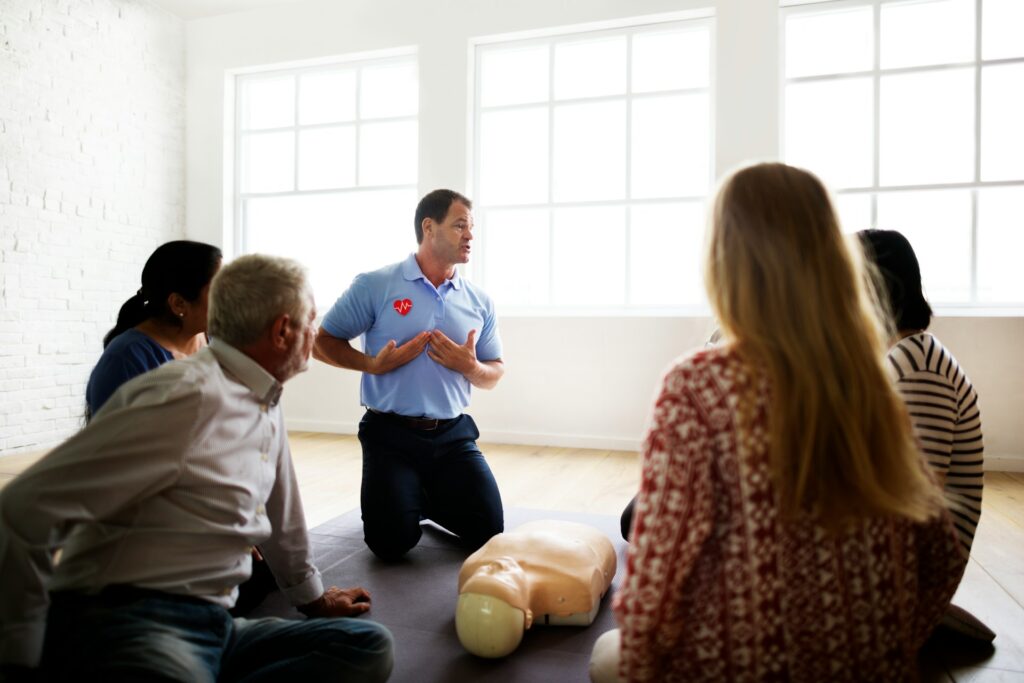
In class, you do much more than watch a video. You get instructor-led practice on manikins so you can feel how hard to push and how fast to go. Many new students are surprised by how much force it actually takes and how quickly they start to feel tired.
We coach you on:
- Correct hand placement in the center of the chest
- Using your body weight instead of just arm strength
- Switching with a partner every couple of minutes
- Speaking up when you are getting tired so quality does not drop
Adult CPR classes in Nashville often include realistic practice drills. You work through scenarios that feel tense and a little stressful on purpose. This helps you learn what fatigue and nerves feel like so you are not caught off guard if you ever have to do CPR for real.
If you ever train in one of our other locations, such as our AHA classes in Uniondale or Troy, you will see that same focus on hands-on quality.
Using an AED Safely and Effectively in an Emergency
An AED, or automated external defibrillator, is a small device that can analyze a heart rhythm and advise a shock when needed. You may see them mounted on walls in offices, gyms, schools, airports, and many other public spaces. Early defibrillation is key in sudden cardiac arrest, which is why learning to use an AED is such a big part of modern CPR training.
In AHA-based adult classes, we break AED use into simple steps:
- Turn the device on
- Expose the chest and place pads where the pictures show
- Listen and follow the voice prompts
- Make sure no one is touching the person during analysis or shock
Safety is a big part of this training. You learn to say “stand clear” out loud and look quickly to confirm that no one is in contact with the person before a shock is given. We also talk about common concerns, such as using an AED on a wet chest or a very hairy chest, and what to do in those situations.
Hands-on AED practice is what usually removes fear. When adults have a chance to open the case, handle the pads, and hear the prompts, they start to trust the device. They see that the AED guides them and will not shock unless it is appropriate.
Working as a Team and Communicating Under Pressure
Real emergencies rarely happen in complete silence. There may be family members, co-workers, or bystanders gathered around. Adult CPR classes in Nashville include team-based practice so you feel ready to speak up and organize the scene.
We show you how to:
- Assign clear roles, such as compressor, AED operator, and caller to 911
- Use short, direct phrases instead of long explanations
- Repeat back important tasks so nothing gets missed
This style of talking is called closed-loop communication. For example, one person might say, “You start compressions,” and the other responds, “Starting compressions now.” That quick loop cuts down on confusion and helps everyone stay on the same page.
Even when you are the only trained person there, communication still matters. You may need to:
- Ask someone to bring the AED from the hallway
- Direct another person to meet EMS at the door
- Explain to the 911 dispatcher what you see and what you are doing
We sometimes share how this type of team approach also applies in other training sites like our AHA classes in Santa Barbara, where teamwork and calm language are practiced in the same way.
Beyond CPR Skills: Legal, Emotional, and Practical Readiness
Good CPR training also talks about the parts that are not physical skills. Many adults hesitate because they are worried about legal issues. In class, we cover general Good Samaritan protections in simple terms, so you understand that people who act in good faith to help are often protected when they provide reasonable aid.
We also address what it feels like to be in the middle of a real emergency. Your heart may pound, your hands may shake, and you might feel emotional afterward. Instructors discuss:
- How to focus on the next small step instead of the big picture
- How to accept that outcomes are not in your control
- How to seek emotional support after a difficult event
Finally, we talk about what happens when EMS arrives. You learn when it is appropriate to stop CPR, how to move out of the way safely, and what information to share, such as when you started CPR, how long you have been compressing, and how many AED shocks were given.
Skills can fade with time, so adult CPR classes in Nashville also explain certification timelines, the value of refreshers, and staying current with AHA guidelines. Regular practice keeps the motions sharp and the fear smaller, so if the day comes when someone near you collapses, you will be ready to act with calm, trained hands.
Protect Lives With Trusted CPR Training Today
If you live or work in the area, our adult CPR classes in Nashville make it easy to gain the skills and confidence to respond in an emergency. At CPR, AED, and First Aid Certifications, we provide clear, hands-on training that fits your schedule and meets recognized guidelines. Reserve your spot today so you are prepared to act when every second counts, or contact us with any questions before you get started.