Durham, NC CPR Acceptance: AHA vs. Red Cross, Online Rules, HR Card Checks
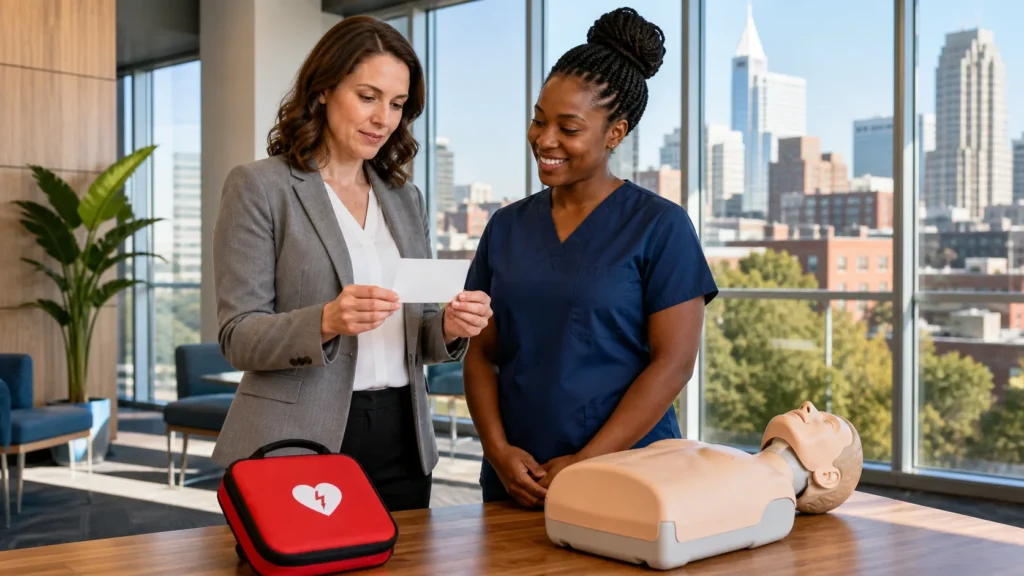
Durham Employers’ Guide to Verifying CPR Credentials
When your team is responsible for patient care, child safety, fitness clients, or high-risk work, guessing about CPR credentials is not an option. Durham, NC, employers need clear rules so HR can approve the right classes, reject the wrong ones, and keep records that hold up during audits.
Here, we focus on a simple question: which CPR classes in Durham, NC will HR actually accept, and how can you tell if a card is real? We will look at what “employer-approved” really means, why American Heart Association (AHA) courses are so often required, how online and hybrid classes fit in, and a step-by-step checklist HR can follow to verify cards the same way every time.
What Employer-Approved CPR Training Really Means in Durham
Not every CPR class is designed for the workplace. Some are meant for community members who just want basic skills, while others meet strict rules for jobs that fall under OSHA-related safety needs or healthcare standards.
For Durham employers, “approved” usually means:
- The class matches the risk level of the job
- The training provider is recognized and credible
- The card is current, not expired
In healthcare, childcare, and many higher-risk jobs, employers often look for workplace-level or healthcare-level certifications instead of simple community CPR. That means they want CPR training that covers:
- Adult, child, and sometimes infant CPR, depending on the role
- Use of an AED
- Choking response
- Basic First Aid for injuries and sudden illness in some positions
Many hospitals, clinics, and medical practices in Durham often require AHA BLS Provider or AHA Heartsaver courses for hiring and ongoing credentialing. Job descriptions, employment contracts, and liability insurance expectations all push HR to stick with specific course types and to require proof that cards are current.
AHA Courses and What Durham HR Teams Look For
The American Heart Association is widely seen by healthcare and clinical workplaces as the top standard for CPR, AED, First Aid, and BLS. When HR sees “AHA” on a card, it usually signals that:
- The science is evidence-based
- The training includes hands-on skills
- The course content matches national guidelines
The main AHA course families most Durham employers deal with are:
- Heartsaver CPR AED: Often used for fitness staff, security staff, and general employees who may need to respond to cardiac emergencies
- Heartsaver First Aid CPR AED: Chosen for staff who need both CPR skills and basic first aid, such as school staff, childcare workers, and some industrial roles
- BLS Provider: Typically required for clinical roles such as nurses, doctors, techs, dental staff, and any role that gives direct patient care
HR can use a quick AHA check on every card:
- Course title clearly lists AHA Heartsaver or AHA BLS Provider
- The American Heart Association name and logo are present
- Issue and expiration dates are readable
- Instructor or training center information is listed
- The course level fits the employee’s job duties
If a card says “BLS” but does not mention the American Heart Association at all, HR may need to ask more questions or request a different course.
Online, Hybrid, and Classroom CPR Rules for Durham Employers
One of the hardest things for HR right now is sorting out online CPR options. Many websites offer instant online CPR cards, but that does not mean a Durham employer should or will accept them.
For roles that require hands-on skills, such as healthcare, childcare, and high-risk work settings, most Durham employers expect:
- An in-person skills check with an instructor
- Correct use of manikins and AED trainers
- Assessment of compressions and breaths
AHA offers blended learning, which combines online coursework with a required in-person skills check. The online part covers videos and written material, then the student meets an AHA instructor for hands-on testing. When documented correctly, the blended AHA options are usually treated like a regular classroom course.
A simple HR acceptance framework in Durham looks like this:
- Fully in-person AHA classroom course: generally acceptable for most roles
- AHA blended/hybrid course with a documented in-person skills check: typically acceptable
- Non-AHA, 100 percent online CPR card with no skills check: often questioned and may need written approval from a regulator or credentialing group, if accepted at all
Step-by-Step HR Checklist to Verify CPR Cards in Durham
To make CPR checks faster and more consistent, HR teams in Durham can follow the same steps for every new hire and renewal:
- Request a clear copy of the CPR card, front and back if needed.
- Confirm the course name and provider, looking for “American Heart Association” and the correct course title such as Heartsaver or BLS Provider.
- Match the course level to the job. Healthcare roles usually need BLS Provider. Non-clinical staff may be fine with Heartsaver.
- Check the issue and expiration dates. If the card is expired, it does not meet most job requirements.
- Look for the instructor name, training center name, or ID information.
When HR is not sure if a card is real or valid, extra steps can help:
- Compare the card layout to official AHA sample cards
- Use AHA’s eCard verification tool when the card lists an eCard code
- Call or email the training center that issued the card and confirm the student’s name and course
To avoid guesswork, many HR leaders in Durham also write an internal CPR policy that spells out:
- Which AHA courses are accepted for each job type
- How often employees must renew
- What documentation format is required, paper cards or eCards
- How contractors and temporary staff must show proof
How Durham Employers Can Simplify CPR Compliance Now
When Durham employers rely on clear AHA standards and a simple HR checklist, CPR compliance becomes much easier. Hiring moves faster because recruiters know exactly what to ask for. Audits are smoother because records are complete and consistent. Risk drops because everyone with a card has passed hands-on skills, not just watched a video.
Working with reliable, instructor-led AHA training providers in Durham that offer same-day certification cards and flexible class times can also cut down on delays for new hires, renewals, and group training. With a stable partner, HR can keep a predictable training calendar, track expiration dates, and be confident that every CPR card on file actually means the employee is trained to respond in a real emergency.
Protect Your Community With Lifesaving Skills
If you are ready to be the person others can count on in an emergency, our CPR classes in Durham, NC give you the hands-on training you need. At CPR, AED, and First Aid Certifications, we focus on real-world practice so you leave confident and prepared to act. Reserve your spot today or contact us with any questions about upcoming course dates and group options.