King of Prussia Security Guard CPR/AED Readiness Drill Plan and AED Placement
Why CPR Readiness Matters for King of Prussia Security Teams
Security guards in King of Prussia are often the first people called when something goes wrong. When a guest, employee, or shopper goes into cardiac arrest, those first few minutes before EMS arrives can make all the difference. That is exactly where strong CPR and AED skills come in.
American Heart Association CPR and AED training gives security guards a clear step-by-step way to act during a cardiac arrest, choking situation, or breathing emergency. For large office parks, malls, corporate campuses, hotels, warehouses, and event venues, trained guards add a powerful layer of protection. Here, we will walk through how to turn CPR cards into real readiness with drills, clear roles, and smart AED placement that fit King of Prussia properties.
Turning AHA Cards Into Real-World Readiness
Finishing an American Heart Association CPR and AED course is an important first step. But for security teams that protect large buildings and busy public spaces, the real goal is staying ready every single day.
Supervisors can help guards keep skills sharp by building CPR practice into normal work life, for example:
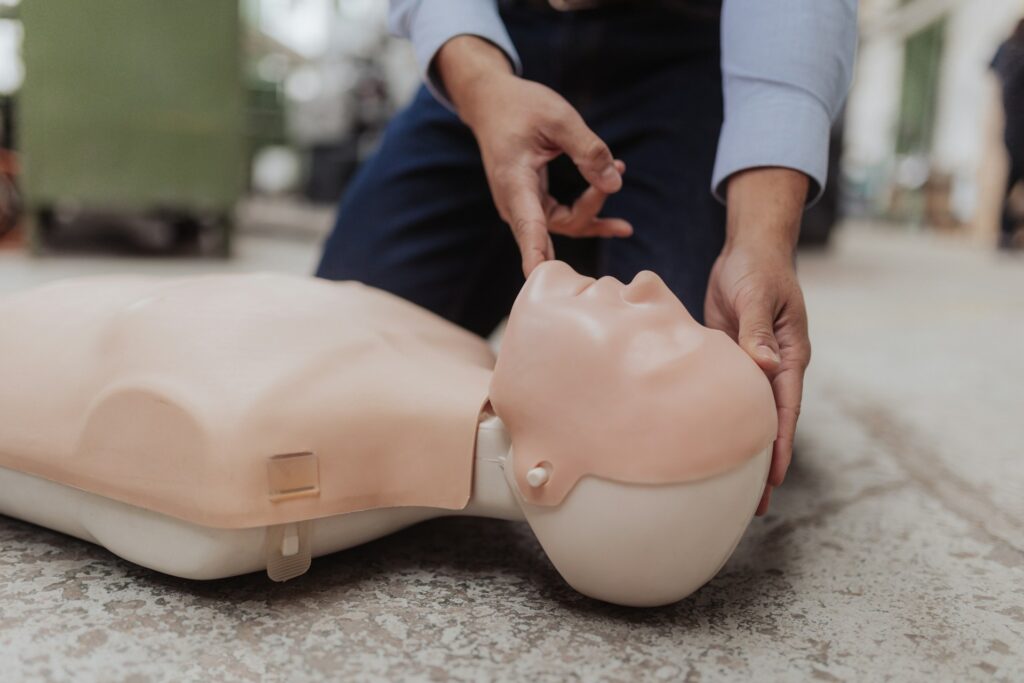
- Short compression practice on a manikin in the guard room
- Timed practice for turning on an AED and placing pads correctly
- Verbal walk-throughs of scene safety and victim assessment
- Quick review of when to switch rescuers to avoid fatigue
A helpful rhythm is a structured skills refresher every 60 to 90 days. These do not need to be long. Many teams use shift changes for 10-minute huddles that cover one focused topic at a time, such as:
- One week: high-quality chest compressions
- Next week: AED power-on and pad placement
- Another week: effective 911 communication and location details
That way, current AHA guidelines and techniques stay clear in everyone’s mind, instead of fading between certification dates. Some teams even compare notes across locations, similar to how teams at our Uniondale AHA training site share what works for them.
Designing Post-Certification Drills for Security Teams
A structured drill plan is one of the best tools for security leadership. Drills turn classroom skills into real, repeatable habits that work under pressure.
A simple drill framework for security guards can look like this:
- Alarm or radio call from dispatch or a role player
- Target time for first responder to reach the scene
- Quick scene safety and victim check
- Start of chest compressions
- AED retrieval, power-on, and pad placement
- Delivery of first shock if advised
- Smooth handoff report when EMS arrives
Each drill should be timed from the first call to the first compression and to the first AED shock. Afterward, supervisors can lead a short debrief. Keep the tone supportive, not harsh. Ask what went well and what felt confusing.
To build confidence, start with simpler drills, such as a single guard responding to a quiet hallway incident. Then move to more complex situations that match real King of Prussia sites:
- Multi-guard response in a crowded lobby
- Victim in a parking garage with vehicle traffic
- Incident in a loading area with noise and equipment
Key evaluation points can include:
- Time from call to arrival at the victim
- Time to first compression
- Time to first AED shock
- Compression rate and depth when using a manikin with feedback
- How clearly roles were assigned and followed
- How closely steps matched AHA-based protocols
Repeating these kinds of scenarios over time helps guards react with calm, trained reflexes, not panic.
Site-Specific CPR Roles for King of Prussia Facilities
King of Prussia has many different property types, from multi-story office complexes to enclosed malls, medical offices, and industrial parks. CPR training for security guards in King of Prussia works best when it is matched to these unique layouts.
We suggest defining clear roles for each security post:
- Primary rescuer: starts compressions and uses the AED
- Secondary rescuer: manages scene safety, crowd control, and equipment
- Communications lead: calls 911, informs internal contacts, meets EMS
In a mall or corporate campus, it helps to pre-assign backup responders by zone. That way, if the primary officer for a zone is off-duty or already tied up with another incident, the next-closest trained guard knows they are next in line for CPR and AED response.
Site walk-throughs are useful too. Supervisors can walk floors with their teams and talk through:
- Where a sudden cardiac arrest is most likely to be missed or delayed
- Which stairwells, elevators, or service corridors slow response
- How to guide EMS from main entrances to harder-to-find locations
Similar walk-through methods are used by other organizations that train with us, such as teams that attend classes at our Troy AHA program location.
Strategic AED Placement and Coordination with Security
Good AED placement is just as important as proper CPR technique. For large King of Prussia properties, security leaders should work with building management to map out high-traffic and high-risk areas. Common locations include:
- Food courts and cafeterias
- Fitness rooms and employee gyms
- Conference centers and meeting areas
- Guest floors in hotels
- Loading docks and warehouse aisles
The goal is that guards can reach an AED, bring it back, and apply pads within about 2 to 3 minutes. That often means placing AEDs near main paths of travel, not hidden in back offices.
Security patrols are a great time to check AED readiness:
- Look at the battery indicator light
- Check pad expiration dates
- Make sure cabinets and cases are not blocked or locked
- Confirm any alarms or access codes are working
AED locations, access instructions, and any key details should be written into security post orders. Those orders need to match what guards practice during CPR drills, so there are no surprises during a real emergency. Teams that have trained with our Santa Barbara AHA courses often use the same approach, making AED checks a routine part of security work.
Building a King of Prussia CPR-Ready Security Culture
To keep CPR training for security guards in King of Prussia strong over the long term, it helps to treat it as a core security skill, not just a one-time box to check. Managers can link CPR and AED readiness to performance reviews, promotions, and leadership roles, so guards see that these skills really matter.
Some ways to keep motivation high include:
- Posting anonymous drill performance stats on internal boards
- Recognizing guards who show clear thinking and solid skills during drills
- Rotating guards as drill leaders so more people practice giving directions
- Asking for feedback after every drill to keep improving the plan
As an American Heart Association training provider, we see that the best results come when teams train regularly, practice often, and talk openly about what works and what needs adjustment. When that happens, security staff across King of Prussia do not just hold CPR cards. They stand ready to act with clear roles, solid skills, and confidence whenever a cardiac emergency happens on their watch.
Protect Your Team With Professional CPR Certification
Security incidents unfold quickly, and the right CPR skills can be the difference between life and death. At CPR, AED, and First Aid Certifications, we provide specialized CPR training for security guards in King of Prussia so your staff can respond confidently in critical moments. Schedule a course that fits your team’s needs, and we will help you meet compliance requirements while strengthening on-site safety. If you have questions about class options or group scheduling, please contact us today.