Understanding AHA BLS Recertification for Nurses in Cincinnati
Why Cincinnati Nurses Rely on AHA BLS Renewal
Basic Life Support, or BLS, is the foundation of emergency care for nurses. It is the set of skills you use when a patient has no pulse, is not breathing, or is choking. In Cincinnati hospitals, clinics, and long-term care facilities, BLS is a core requirement because it helps nurses act quickly in those first life-saving minutes.
Most employers in the area look for American Heart Association, or AHA, BLS training. AHA sets nationally recognized standards that nurse managers and education teams know and trust. When your BLS card is current, it shows your workplace that you are ready to respond to cardiac arrest, respiratory arrest, and choking in adults, children, and infants.
Timely recertification is not just paperwork. It keeps your skills sharp so you can move right into compressions, breaths, and AED use without stopping to think. In a real code, that comfort and speed can make a very real difference.
What AHA BLS Recertification Covers for Nurses
An AHA BLS recertification class for nurses brings you back to the core skills you need during a code or rapid response. You review high-quality CPR and how to give strong, steady compressions with good recoil so each push counts.
Key skills you can expect to practice include:
- Adult, child, and infant CPR with single and two-rescuer techniques
- Use of a bag-mask device with proper seal and volume
- Coordinated team response with clear roles and communication
- Quick rhythm checks with minimal pauses in compressions
AED operation is another big focus. You review how to:
- Turn the AED on quickly and follow its prompts
- Place pads correctly on patients of different sizes
- Clear the area safely before a shock
- Restart compressions without delay after a shock is delivered
Recertification also reinforces current AHA guidelines on compression depth and rate, ventilation strategies, and how to avoid long breaks in compressions. That way your habits match what your unit expects during mock codes and real events.
When Cincinnati Nurses Need to Renew BLS Certification
AHA BLS certification is usually valid for two years. Many Cincinnati hospitals keep close track of those expiration dates, because they must stay in line with policies, accrediting bodies, and safety standards.
Letting your BLS card expire can create problems at work, such as:
- Being removed from direct patient care until you renew
- Having fewer options for preferred shifts or units
- Delays in moving into charge, preceptor, or specialty roles
To avoid last-minute stress, it is smart to plan ahead. A helpful rule is to schedule your recertification about 30 to 60 days before your card expires. That gives you time to find a class that fits your schedule, arrange coverage if needed, and deal with any unexpected changes.
If you know you have a new role coming, like working in a higher-acuity unit or starting in a new facility, updating your BLS early can also help. Some nurses plan recertification around annual skills fairs or unit education days so everything stays in sync.
How AHA BLS Recertification Works Step by Step
With CPR, AED, and First Aid certifications, the process is built to be simple. You start by using our online enrollment to pick the AHA BLS course made for healthcare providers. Even though our training centers are based in several cities, such as our Troy location, the process for nurses in any area is similar, with clear course options and dates.
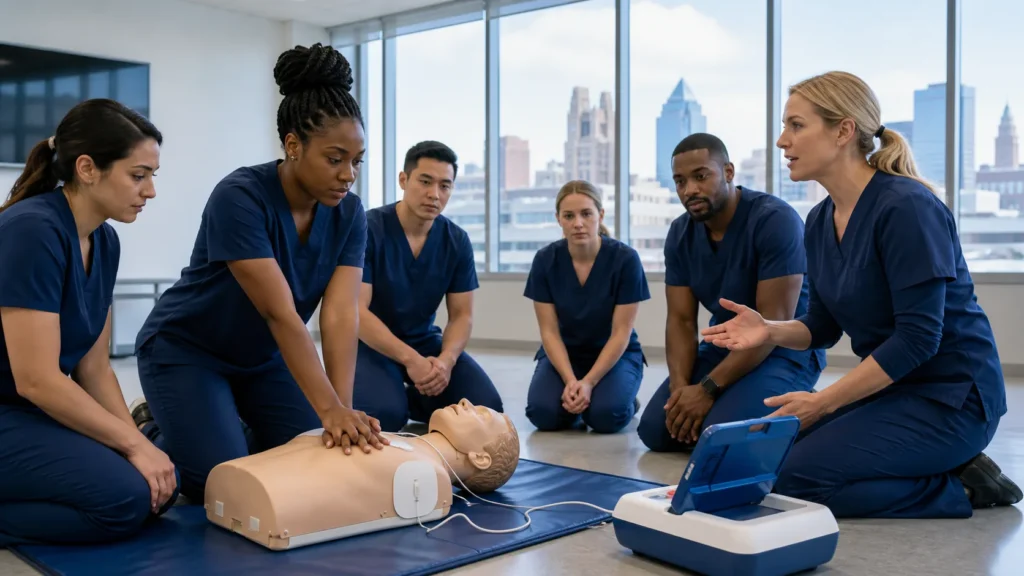
Once you arrive for class, you can expect an instructor-led experience that focuses on hands-on practice. The typical class flow includes:
- Brief review of key AHA BLS concepts for healthcare providers
- Instructor demonstration of CPR, bag-mask use, and AED operation
- Practice on adult, child, and infant manikins with feedback
- Team-based scenarios that feel like real hospital or clinic events
- A written assessment that checks your understanding of AHA material
During skills checkoffs, you perform CPR, use the bag-mask device, and operate the AED while the instructor checks your technique. You get coaching in real time so you can adjust your hand placement, compression depth, or timing between breaths and compressions.
After you successfully complete both the skills and knowledge parts, you receive a same-day certification card. This helps you update your employee records right away so there are no gaps in your file.
Choosing the Right BLS Course Provider in Cincinnati
Not all BLS classes are the same, especially for nurses who work in busy clinical settings. When you choose a provider, it helps to look for a few key things.
Helpful features to watch for:
- AHA-compliant BLS for healthcare providers curriculum
- Instructors with real-world clinical or resuscitation experience
- Plenty of hands-on time with manikins and AED trainers
- Courses clearly marked for nurses and other medical staff
Some nurses prefer fully instructor-led classes, where everything is done in person. Others like blended formats, with online learning followed by an in-person skills session, similar to options at sites like our Uniondale training location. In either case, the in-person portion is where confidence grows, because you practice until the skills feel natural.
Scheduling and location also matter.
- Evening or weekend classes that fit around 12-hour shifts
- Locations with easy access from major hospitals or main roads
- Class lengths that you can realistically finish in one visit
A provider that regularly trains healthcare teams, like our site in Santa Barbara, usually understands how to tailor examples and scenarios to real code situations nurses face.
Maximize Your Next BLS Renewal for Real Emergencies
BLS renewal is more than just keeping a card up to date. It is a chance to sharpen how you work during a code, from your first assessment to how you speak up in a busy room.
You can get more out of your next class by:
- Thinking back on recent mock codes or real events on your unit
- Noting any steps where you felt unsure or slow to act
- Writing down questions about rhythms, compressions, or AED use
- Asking your instructor to walk through scenarios that match your unit
Treat each practice round like it is the real thing. Call out what you are doing, listen for feedback, and work on clear, calm communication. Over time, those habits become automatic, so when an alarm goes off and a patient needs help, you can step in with steady hands and a clear plan.
Advance Your Nursing Career With Trusted Local BLS Training
If you are ready to keep your skills current and your patients safer, schedule your next class for BLS for nurses in Cincinnati with CPR, AED, and First Aid Certifications. Our team will help you find course dates that fit your schedule so you can meet employer and licensing requirements without added stress. If you have questions about group bookings or specific credential needs, simply contact us and we will walk you through your options.