Santa Barbara AHA CPR Class Formats: In-Person vs. Blended vs. Online
Choosing the Santa Barbara CPR Class Format That Actually Works
Picking CPR classes in Santa Barbara is not just about finding any open seat. The format you choose can decide if your card is accepted by your boss, your school, or your licensing board. That matters if you work in healthcare, childcare, fitness, education, or any job that has CPR listed as a requirement.
The American Heart Association (AHA) offers three main ways to complete CPR training: fully in-person, blended learning, and fully online. These formats are not treated the same by employers. Some meet workplace rules, and some do not. If you pick the wrong type, you might end up with a card that does not count.
In this guide, we will break down what each format really means, how employers in and around Santa Barbara usually see them, and which choices lead to an official AHA eCard that works for real job and licensing needs.
What Employers Mean by “AHA CPR Certification”
When an employer says, “We need AHA CPR,” they usually are not talking about any basic CPR class. They are asking for a course that is created by the American Heart Association, taught by an AHA instructor, and finished with an official AHA eCard.
There are many “CPR-style” trainings out there that use similar wording or colors but are not AHA courses. These might give you a paper certificate or a printable card, but that is not the same as an AHA eCard.
Most medical and clinical employers in the Santa Barbara area look for things like:
- AHA BLS Provider for healthcare workers
- AHA Heartsaver CPR AED or Heartsaver First Aid CPR AED for non-clinical staff
- A valid AHA eCard that can be verified
- An expiration date that meets their 2-year renewal cycle
Licensing agencies and employers usually expect:
- Hands-on skills practice on adult, child, and infant manikins
- Instructor-led skills testing, not just a quiz
- Training that follows current AHA Guidelines for CPR and ECC
Many will accept AHA blended learning, because the skills test is still done in person. What they usually do not accept is a 100 percent online CPR course that never puts you in a room with an instructor and a manikin.
In-Person AHA CPR Classes in Santa Barbara
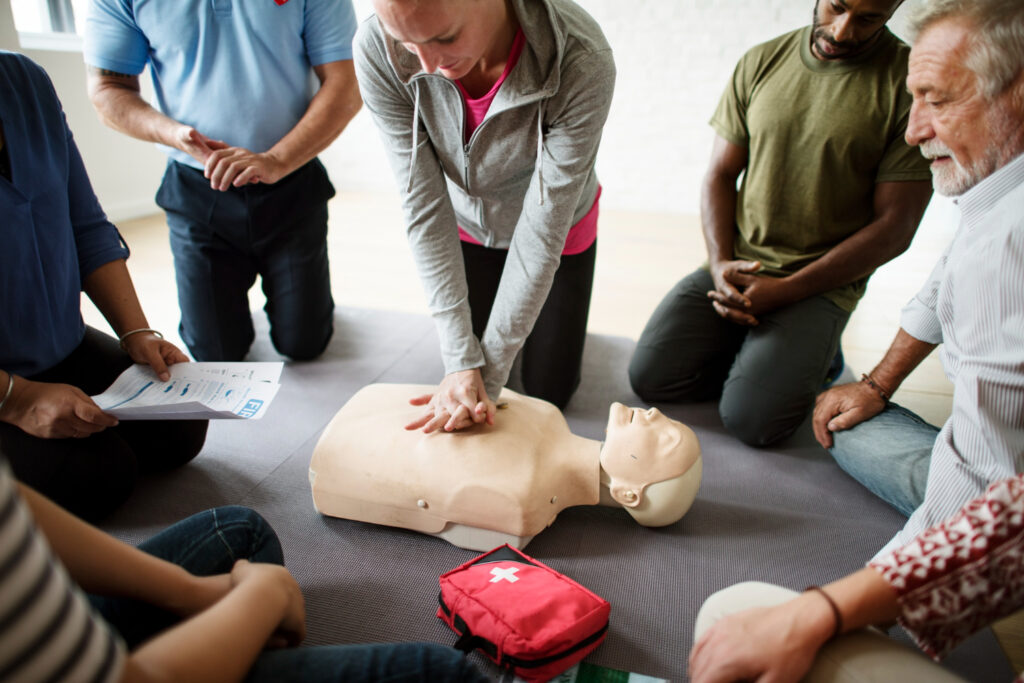
In-person AHA classes mean you do everything in the classroom. You watch course videos, learn from an AHA-certified instructor, practice skills, and complete your test all during the same in-person session.
These classes tend to be the best fit for:
- First-time CPR students
- People who feel nervous about emergencies
- Healthcare providers who need AHA BLS Provider
- Workplaces that want on-site group training
The main benefits of fully in-person CPR classes are simple:
- Immediate feedback on your hand position, depth, and rate of compressions
- Guided practice with adult, child, and infant manikins
- Realistic AED practice so you know what to do under stress
- Time to ask questions and go over tricky parts
Because the training and testing are all done live, fully in-person AHA CPR is almost always accepted by hospitals, clinics, schools, and many licensing boards. If you are not sure what your employer will take, this format is usually the safest choice. You can see examples of in-person AHA class options at our Santa Barbara page for local AHA CPR training.
Blended AHA CPR Classes: Online Study Plus Local Skills
Blended learning is a mix of online work and in-person skills. With AHA blended courses, you complete the official AHA online module at your own pace. After that, you attend a scheduled, hands-on skills session in Santa Barbara to show your CPR and AED skills to an instructor.
Blended AHA CPR works well for people who:
- Have tight schedules and want to do most content at home
- Are renewing an existing AHA BLS or Heartsaver card
- Prefer a shorter time in the classroom
- Are comfortable learning from videos and text on a computer or tablet
From the employer side, blended AHA courses are often accepted because:
- The online piece is official AHA content
- The in-person skills check is still required
- An AHA instructor confirms your skills before you receive your eCard
During the skills appointment, you still perform:
- High-quality chest compressions and rescue breaths
- Use of a barrier device for ventilations
- Team-based basic life support for healthcare roles
- AED operation and troubleshooting
If you already understand the basics and just need a renewal that still counts as real AHA training, blended learning can be a good fit. Some students even choose blended formats in other cities, like the AHA classes offered in Uniondale or Troy, when they are traveling or moving.
Fully Online CPR Courses: When They Are and Are Not Enough
You may see ads for “instant online CPR certification” that can be done from your phone in an hour. Most of these programs are not connected to the American Heart Association and do not include any in-person skills practice.
The AHA does not issue completion cards for CPR or BLS courses that are 100 percent online with no live skills check on a manikin. For AHA, hands-on testing is a required step to earn an eCard.
In the Santa Barbara area, most of the following will not accept a fully online CPR card as job-ready proof:
- Hospitals and clinics
- Dental offices and surgery centers
- EMS and transport services
- Many childcare and preschool programs
That does not mean online-only CPR is always useless. It might be fine if:
- You want CPR awareness for personal reasons
- You are in a volunteer role with no formal certification need
- Your organization only asks for basic training, not a specific AHA card
Still, if any part of your job description mentions American Heart Association, BLS, or “hands-on CPR,” a fully online course by itself almost never reaches that standard.
How to Confirm Your CPR Class Meets Santa Barbara Job Requirements
Before you enroll in any CPR class, a quick check can save you a lot of trouble. Here is a simple checklist:
- Confirm that the course is from the American Heart Association
- Check the exact card type you will receive, like Heartsaver CPR AED, Heartsaver First Aid CPR AED, or BLS Provider
- Make sure there is an in-person skills part, either in a full class or a skills session
It is smart to ask your employer, school, or licensing board in Santa Barbara questions like:
- Do you accept AHA blended courses, or do you require fully in-person?
- Do you need BLS Provider or Heartsaver CPR AED?
- Does the certification need to include first aid?
When you talk to any local training provider, you can ask:
- How long is the in-person skills portion?
- Is the instructor certified to teach American Heart Association classes?
- Will I receive an AHA eCard, and when will I receive it?
- Is this certification valid for my type of workplace or clinical role?
Choosing an instructor-led AHA program with clear skills testing and same-day eCards makes it much easier to meet common workplace and healthcare standards in Santa Barbara. Being sure about your format before you enroll helps you avoid repeating a class or missing a deadline later.
Protect Lives With Expert CPR Training Today
If you are ready to feel confident in an emergency, our CPR classes in Santa Barbara give you practical skills you can use right away. At CPR, AED, and First Aid Certifications, we offer American Heart Association courses tailored to workplaces, families, and health professionals. Reach out with questions or scheduling needs anytime through our contact page. Start your training now so you are prepared when every second counts.